
Strategic Thinking Bootcamp
What started as a highly engaging, discussion-based classroom training needed to become something scalable, without losing what made it powerful in the first place.
This three-module e-learning experience takes learners through the full journey of strategic thinking. Not by telling them what to do, but by placing them inside a realistic business challenge where they have to figure it out themselves.
From framing the right question to delivering a clear recommendation, learners experience what it actually means to think and act strategically.
Built For
A global chocolate and cocoa manufacturer looking to scale a facilitator-led strategic thinking training into an engaging digital learning experience.
Project Details
- Role: e-Learning Developer and Instructional Designer
- Focus: Structured Strategic Thinking
Tools
- Articulate Storyline
- Vyond
- HeyGen
- Canva
- Adobe Acrobat Pro
Skills
- Instructional Design
- e-Learning Development
- Animated Video
- Presented-led Video
- Graphic Design
- Fillable PDF Worksheets
Note
All company logos, branding, and sensitive business information have been removed or anonymized from the visuals featured in this case study. If you’d like to learn more about the project or discuss a similar learning challenge, feel free to get in touch.
💡My Approach
The challenge was clear: how do you scale a discussion-driven training without losing the thinking that makes it valuable? So instead of translating the training, I rebuilt the experience around a story.
Learners step into the role of Alex, a finance analyst tasked with evaluating a potential investment in a new production line. It’s not presented as a case to read, it’s a situation to navigate.
Each module reflects a phase professionals recognize from real work. First, making sense of the problem. Then structuring the work and communicating along the way. And finally, bringing it all together in a recommendation that drives a decision.
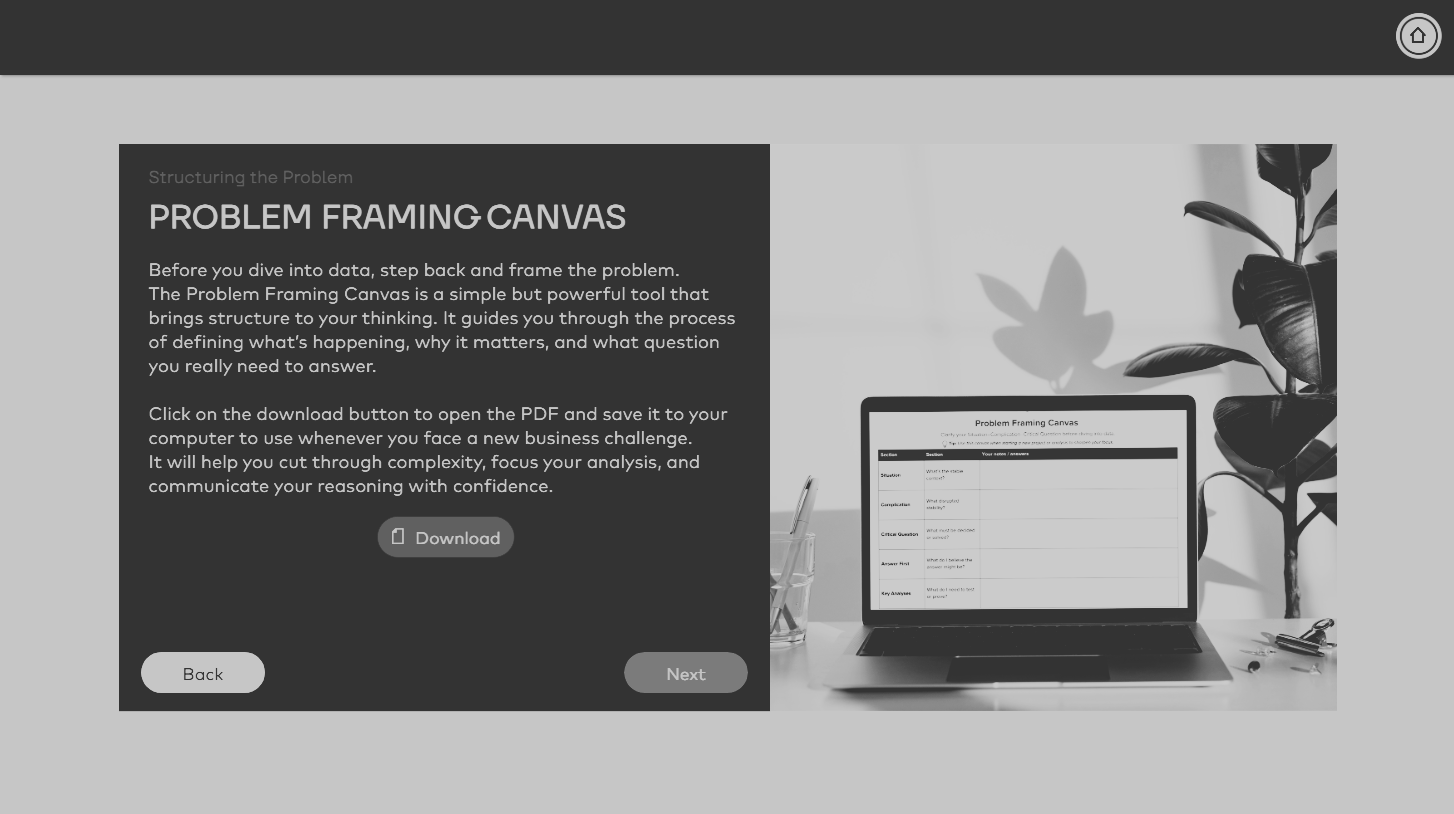
Rather than overwhelming learners with theory, concepts are introduced exactly at the moment they’re needed. Short explanations create just enough clarity to move forward, after which learners are asked to apply the thinking themselves. Each module is supported by practical, downloadable tools, designed as on-the-job references to help learners apply the same structure in their daily work.
The result is a learning flow that mirrors reality: unclear at the start, structured through practice, and increasingly focused as decisions take shape.
🔧The Build
The experience unfolds across three connected modules, all centered around the same business challenge.
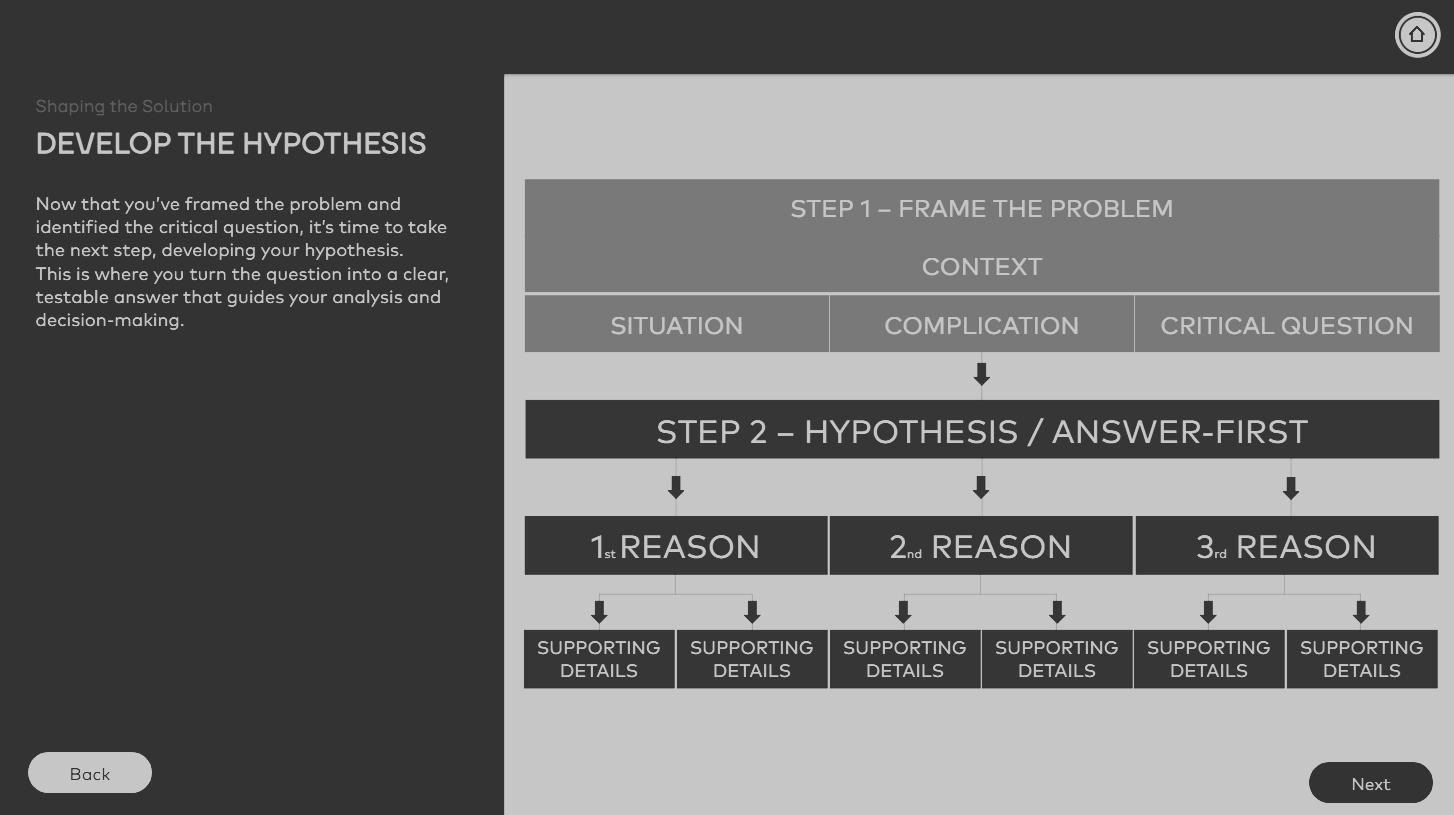
In the first module, learners are confronted with the initial question and quickly realize the real challenge isn’t solving it, but defining it properly. They work through framing the situation, identifying the core complication, and sharpening the key question. Concepts like Answer-First thinking and MECE (Mutually Exclusive Collectively Exhaustive) are introduced not as theory, but as practical tools to move forward.
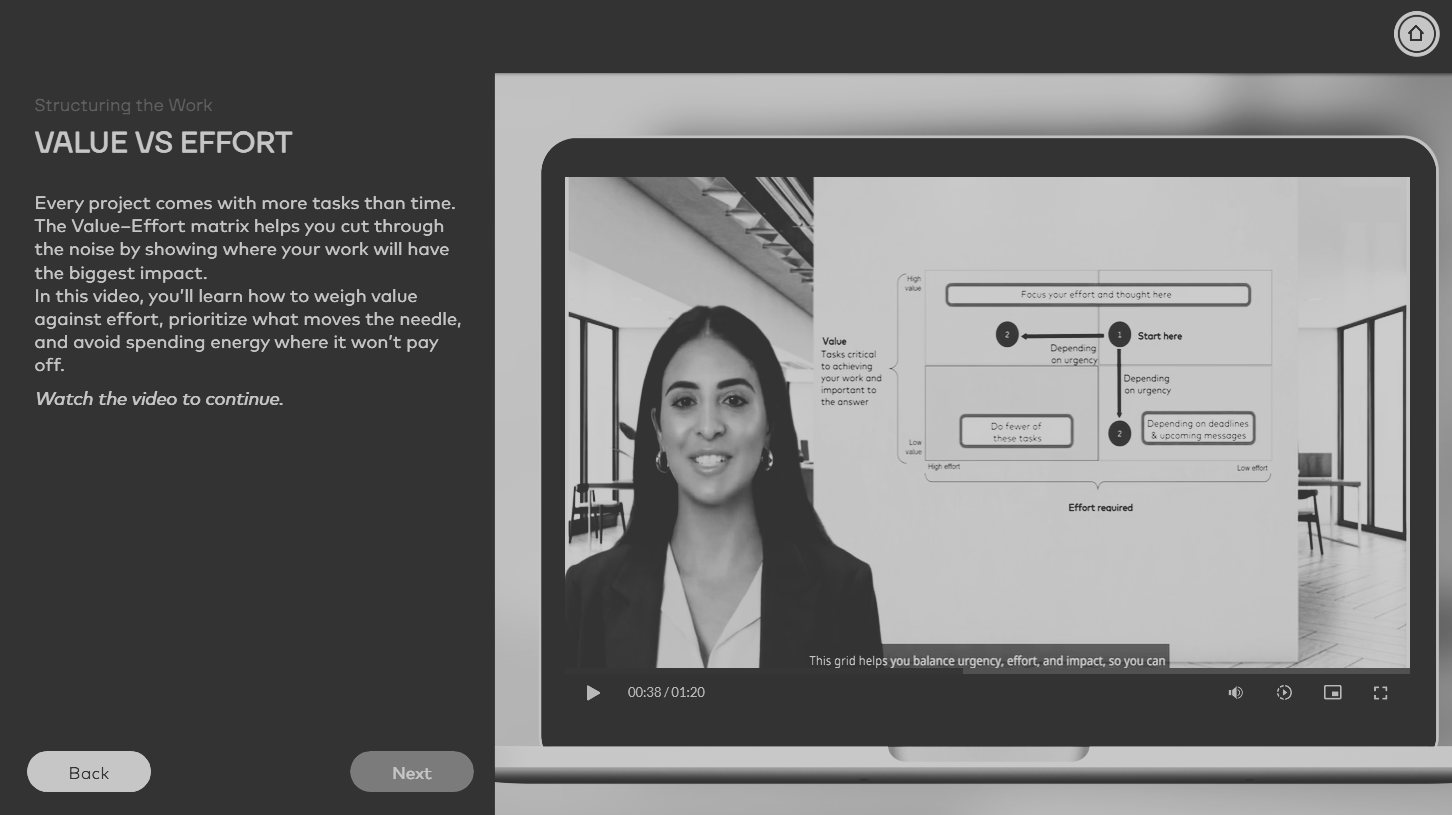
In module two, the focus shifts from thinking to doing. Learners structure their work, prioritize what matters, and communicate progress clearly. Through interactions like prioritization exercises and short update scenarios, they experience the difference between sharing effort and sharing insight.
In the final module, everything comes together. Learners translate their analysis into a clear, structured recommendation and learn how to guide an audience through their thinking in a way that supports decision-making.
Throughout the experience, interactions guide thinking step by step, revealing structure, prompting decisions, and providing immediate feedback. Short animated videos, created in Vyond, introduce key concepts, while the experience is built in Articulate Storyline to enable layered interactivity and a cohesive narrative flow. Presenter-led videos, created using HeyGen, provide clear guidance throughout. Downloadable tools were created with Canva and Adobe Acrobat Pro.
✅The Result
The program is now used as preparation for strategic work within the organization. It helps learners approach complex problems with more structure, communicate with greater clarity, and turn analysis into actionable recommendations.
In doing so, it closes the gap between understanding strategy and actually applying it in day-to-day work.